This Is The Best French Coffee Press

"A great French press turns coarse grounds, hot water, and four patient minutes into a full-bodied cup. The best models hold heat, trap grounds, and clean up fast. This guide explains how presses work, which specifications matter, and how to choose one that fits your mornings."
A French coffee press is the simplest way to brew rich coffee at home. It needs no paper filters, no pods, and no power. You add grounds, pour hot water, wait four minutes, and press.
Presses do not all perform the same. Material, size, and filter quality change both taste and lifespan. This guide covers history, specifications, benefits, care, and a five-step buying process. It also shows how water temperature, grind size, and steep time shape the cup.
Fuller Flavor
OILS STAY IN CUP
Zero Waste
NO PAPER FILTERS NEEDED
Easy Mornings
BREW IN FOUR MINUTES
Each benefit depends on build quality. A thin mesh, a wobbly plunger, or a cracked beaker ruins the cup. The sections below show what to check before you buy.
🍳
Our Top Pick
Cook Without the Forever Chemicals
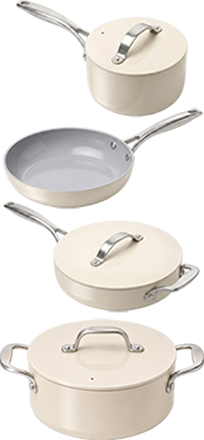
Switch to cookware free of PFAS, PTFE, and PFOA. The CARVER Pure Ceramic Cookware Set gives you seven pieces with a non-toxic ceramic coating. Food slides off, and cleanup takes seconds.
✦ Editor's Pick ✦
★★★★★
CARVER Pure Ceramic Cookware Set Infused with Mineral Stone
Safe Even if Scratched · Effortless Food Release · Built for Years
Cook with confidence on a 7-piece non-stick ceramic set built on an aluminum core with a scratch-resistant mineral-infused coating.
- Non-toxic ceramic coating
- PTFE, PFAS, and PFOA free
- Even-heating aluminum core
- Oven safe up to 550°F
- Induction compatible
- Dishwasher safe
🍳
FROM 1852 TO TODAY
How the Press Evolved
Two Frenchmen, Mayer and Delforge, patented a metal-screen coffee pot in 1852. It used a rod and a screen to hold grounds under the water. The design worked, but it did not catch on widely.
Italian designers Attilio Calimani and Giulio Moneta patented an improved press in Milan in 1929. In 1958, Faliero Bondanini refined the design and produced it in France. The Danish brand Bodum later spread it across Europe and North America.
That mixed path explains the name. The press is "French" by habit, Italian by patent, and global by popularity. It remains a kitchen staple because the mechanism has barely changed in nearly a century.
Modern makers improved the materials, not the idea. Heat-resistant glass replaced fragile early beakers. Stainless steel frames added strength. Finer mesh screens reduced sediment. These upgrades explain why a well-made press today outperforms older models.
🍳
BEAKER, FILTER, PLUNGER
Specs That Matter
Four parts decide how well a press brews. Check each one before you buy.
- Beaker: Holds the coffee. Borosilicate glass resists heat shock. Stainless steel resists drops.
- Filter: A stainless steel mesh traps grounds. Dual screens catch more sediment than single screens.
- Plunger: A tight seal keeps grounds from slipping past the edge.
- Lid and handle: A heat-safe handle and a pour spout prevent drips and burns.
Press sizes count "cups" of 4 ounces: 3-cup is 12 oz, 4-cup is 17 oz, 8-cup is 34 oz, and 12-cup is 51 oz.
|
Material |
Heat Retention |
Durability |
Best For |
|---|---|---|---|
|
Borosilicate glass |
Moderate |
Breaks if dropped |
Home use, beginners |
|
Double-wall stainless steel |
High |
Excellent |
Travel, daily use |
|
Ceramic |
High |
Moderate |
Slow, relaxed mornings |
🍳
SIX REASONS TO PRESS
Press Benefits
Metal mesh keeps natural oils in the cup. Paper filters remove them, so press coffee tastes heavier and rounder.
You also control every variable. Change the ratio, grind, or steep time between batches and taste the difference at once.
🫘
Full body.
Mesh keeps oils in your cup.
🌱
Less waste.
No paper filters to throw away.
💰
Low cost.
No pods and a one-time purchase.
🎚️
Full control.
You set ratio, grind, and time.
⏱️
Fast brew.
Four minutes from kettle to cup.
🔌
No power.
Brew at home, camp, or work.
"My morning cup went from flat to full and rich after I switched to a press. It takes four minutes, and I never buy filters."
— Leah F.
🍳
200°F, FOUR MINUTES
Brew Steps That Work
- Measure 30 g of coffee for 450 ml of water. This is a 1:15 ratio.
- Grind coarse, close to sea salt. Fine grounds slip through the mesh and taste bitter.
- Heat the water to 195–205°F. Boil it and wait 30 seconds.
- Pour and stir. Wet all grounds, stir once, and set the lid on top.
- Steep for four minutes. Longer steeping adds bitterness.
- Press slowly and pour right away. Coffee left on the grounds keeps extracting.
Use whole beans and grind them just before brewing. Medium and medium-dark roasts suit a press best.
🍳
Our Top Pick
Even Heat on Every Cooktop
An aluminum core spreads heat evenly, so pans have no hot spots. The set goes from stovetop to oven at up to 550°F and works on induction.
✦ Editor's Pick ✦
★★★★★
CARVER Pure Ceramic Cookware Set Infused with Mineral Stone
Safe Even if Scratched · Effortless Food Release · Built for Years
Cook with confidence on a 7-piece non-stick ceramic set built on an aluminum core with a scratch-resistant mineral-infused coating.
- Non-toxic ceramic coating
- PTFE, PFAS, and PFOA free
- Even-heating aluminum core
- Oven safe up to 550°F
- Induction compatible
- Dishwasher safe
🍳
RINSE, WIPE, DRY
Keep Your Press Clean
Old coffee oils turn rancid and spoil the next brew. Clean the press after every use.
- Discard grounds in the compost or trash, not the sink.
- Rinse the beaker with warm water right away.
- Unscrew the plunger and separate the mesh screens.
- Wash each part with mild soap and a soft brush.
- Dry every piece before you reassemble it.
Once a month, soak the metal parts in warm water and baking soda for 20 minutes. Never move a glass beaker from hot water to cold.
🍳
SEVEN BAD HABITS
Common Press Mistakes
- Grinding too fine. Fine grounds over-extract and clog the mesh.
- Using boiling water. It scorches the grounds. Let it rest first.
- Steeping too long. Bitterness grows with every extra minute.
- Leaving coffee in the beaker. The grounds keep extracting after you press.
- Pressing too hard. Force pushes fine particles through the mesh.
- Skipping the preheat. A cold beaker weakens extraction.
- Overfilling. Leave one inch of space so the plunger moves freely.
🍳
FIVE BUYING CHECKS
How to Choose
- Pick your size. Match the beaker to your daily servings. A 34 oz press suits two mugs.
- Choose a material. Glass shows the brew. Stainless steel holds heat and survives drops.
- Inspect the filter. Look for fine dual-screen mesh that sits flat at the edge.
- Test the plunger. It should glide straight and seal against the wall.
- Check spare parts. Replaceable filters and beakers extend a press's life.
🍳
BODY, COST, TIME, WASTE
Press Versus Other Methods
|
Method |
Body |
Brew Time |
Waste |
|---|---|---|---|
|
French press |
Full |
4 minutes |
None |
|
Drip machine |
Medium |
5–8 minutes |
Paper filters |
|
Pod machine |
Medium |
1 minute |
Plastic pods |
Choose the press for full body at the lowest cost. Drip machines suit one-button mornings. Pod machines suit speed but cost more per cup.
🍳
Our Top Pick
Built for Years of Cooking
A reinforced, mineral-infused coating resists scratches. Customers rate the set 4.8 out of 5, and a 30-day trial lets you cook risk-free.
✦ Editor's Pick ✦
★★★★★
CARVER Pure Ceramic Cookware Set Infused with Mineral Stone
Safe Even if Scratched · Effortless Food Release · Built for Years
Cook with confidence on a 7-piece non-stick ceramic set built on an aluminum core with a scratch-resistant mineral-infused coating.
- Non-toxic ceramic coating
- PTFE, PFAS, and PFOA free
- Even-heating aluminum core
- Oven safe up to 550°F
- Induction compatible
- Dishwasher safe
🍳
FAQ
What grind size works best in a French press?
Use a coarse grind, similar to sea salt. Fine grounds pass through the mesh and over-extract.
How much coffee should I use?
Start with 30 g of coffee per 450 ml of water. Adjust by 2 g per cup for strength.
How long should coffee steep?
Steep for four minutes. Shorten it for a lighter cup or add 30 seconds for a stronger one.
Is glass or stainless steel better?
Glass shows the brew. Stainless steel holds heat longer and survives drops. Pick based on where you brew.
Can I make cold brew in a press?
Yes. Combine coarse grounds and cold water at a 1:8 ratio. Steep 12 to 16 hours in the fridge.
How do I reduce sediment?
Grind coarser, pour slowly, and let the coffee rest a minute after pressing.
🍳
Final Verdict
The best French coffee press matches your serving size, holds heat, and seals tightly at the plunger. Glass suits home use. Stainless steel suits travel and daily wear.
Fresh, coarse grounds and water near 200°F matter more than any price tag. Follow the five buying checks, avoid the common mistakes, and every four-minute brew will taste full and balanced.
Coarse grounds, hot water, patience: four minutes to a better cup. 🔥